
Part 4: Emotional Expression in Autism
I have been sharing my experiences with autism through my son Krishna’s ongoing story, which is now six years old, post diagnosis.
At the time of diagnosis, however, we knew next to nothing about autism. The word evoked vague memories of Dustin Hoffman in Rainman. Or obscure news stories. Perhaps greeting cards printed by the Spastics Society of India.
And then, our son was diagnosed as autistic. Let me tell you the story of how and why we took him to the doctor in the first place.
When Krishna was 4, he went to school for the first time in his life. At home, he was happy, bubbly, mischievous, energetic, and all that is usually observed of four-year-olds. He was lagging behind in writing, and we thought, that’s what school is for; nothing to worry about. We had no clue that he wasn’t neurotypical. In fact, the words “neurotypical” and “neurodiverse hadn’t entered our world yet.
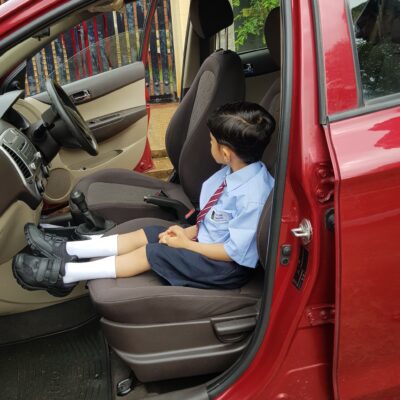
And so. Krishna went to school, all dressed up and cute in his oversized uniform and schoolbag. He seemed happy enough to hold the Ayamma’s hand on the first day and walk off. We anxiously watched him till he disappeared into the maze of corridors and classrooms. I didn’t go back home, though. I had already talked to his teacher during the meet and greet, and told her that I would wait in the reception till his classes were over.
“Krishna has never been in a classroom environment before, Ma’am. We live in a rather secluded gated community. He isn’t used to large groups of people. In case there is an issue, please call me.”
“Don’t worry, Ma’am,” she had responded. “We are all here; we will take care!”
Little did I know the nature of that care.
The week went by seemingly well. Krishna didn’t talk much about what was happening in class. He was seemed his usual energetic self, always happy to set off for school in the morning. On the last day of his first week at school, he came out of class, face swollen and stained with tears. He jumped into my arms and buried his face in my neck, refusing to even look up.
I was shocked.
His class teacher complained to me:
” Ma’am, this whole week Krishna has been jumping in class. He refuses to sit; refuses to talk. Today, he threw a tantrum because he wanted to leave the room. See, I took a video.”
I was numb. I held Krishna in my arms and stared at her. I stared at the video she brandished in my face. Krishna was crying, banging on the projector screen attempting to open it like a door, and glaring into the camera. The teacher was laughing in the background. The rest of the class watched in pin-drop silence (out of camera view).
That was the beginning of six months of severe separation anxiety for Krishna. Six months where his father or I carried him non-stop for every waking second. Six months when he’d scream and scream to take a bath or change his clothes. Six months in which he completely lost toilet training and reverted to diapers 24×7. Six months in which he stopped communicating and responding to us, and would only talk to himself, at night, when cuddled tightly in my arms.
After the school incident, we took him to NIMHANS for an evalutation, and he was diagnosed to be autistic.
“Doctor, what is autism?”
This is what we asked the doctor after 5 days of filling questionnaires describing Krishna’s history. The doctor explained it to us in fairly simple terms:
“Autism is a developmental disorder, mainly impacting the person’s communication and social interactions.”
We still didn’t understand the full meaning and impact of the term “communication and social interactions.”
What is communication? Today, I’d say that communication is understanding your needs, emotions, and desires, and expressing them so that others understand. The other part of communication is understanding others from the words they speak and don’t speak, and also by interpreting their facial expressions and body language.
The foundation of each and every social interaction is communication, isn’t it? Do you like someone or not? How do you decide you like them and would like to interact with them? Whether it is a kindergarten friendship or mingling in an office party, telling your mom that you absolutely hate Riya Daniels because she twisted your arm or evading curious relatives at a wedding party, what is this communication-driven social interaction based on?
Emotion.
And the desire to be recognized for that emotion. The desire to recognize that emotion in others. Speech or writing are the tools for this.
At the time of Krishna’s diagnosis, in 2018, I never thought about it this way. As far as I was concerned, communication was talking. Or perhaps writing an email or a phone message.
So when the doctor said that autism primarily impacts communication and social interaction, I didn’t grasp the full impact of what she was saying. I had absolutely no idea that in practical terms, it meant that my four-year-old little boy would struggle to show or tell me what he was feeling. I had no idea, despite witnessing exactly this.
In school, Krishna had felt severe stress and anxiety. It was the first time he experienced this; how could he understand it and express it to me? Instead, he expressed it by jumping in the class, refusing to sit, and everything else that the teacher accused him of. The doctor explained that while a neurotypical child may express by crying and refusing to go to school, neurodiverse children deal with it by stimming or meltdowns.
Children and adults on the autistic spectrum struggle to interpret emotions and feelings, many times even their own. This constant bombardment on their senses causes stress and anxiety, which is debilitating.
When you smile, is it because:
You’re happy?
You’re being polite?
Your being sarcastic?
When you ask, “How are you,” should they tell you the truth or just mask with “I’m fine?”
And as for you, when you see an autistic person laughing, they may not actually be happy.
When you see them looking at something with wooden expression, they may actually be feeling extreme emotion.
These are just a few simplistic examples, but can you see how this screws up social interactions and communication for them, big time?
I knew none of this; I learned it the hard way. And to this day, almost seven years later, we feel the repercussions in Krishna’s life of that incident in school.
I’ll share more next week. Till then, I hope this is what you will take away:
Autistic children and adults feel emotions as keenly as neurotypical children and adults. But the struggle to express themselves in a way that others understand. Autistic children and adults struggle to understand and interpret body language, subtext, and nuances in social interactions. The more they struggle, the heavier the burden of stress. And this sometimes leads to autistic burnout.