
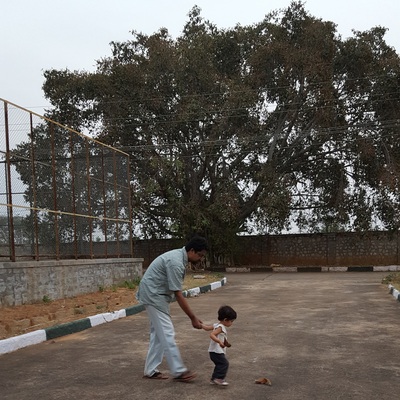
Autism parenting seems a lonely journey. Autism seems a lonely journey.
It needn’t be.
Krishna’s first regression happened when he was about 4.
“That’s not typical,” the doctors told me. “Are you sure you noticed nothing earlier? Very sure?”
The diagnosis of autism was intimidating enough. And then to be told that even within this diagnosis, Krishna was an outlier—well. That was the most lonely feeling in my life. Ever.
Loneliness is not just about being physically alone. It is about not knowing where you belong. About not finding your experience reflected anywhere around you. About feeling that even within a space that should understand you, you are somehow… different.
If what was happening to Krishna was so strange, so different, then where would I find support and help for him and for us, his parents?
How would we move forward? How would we enable our child to live the best possible life that he can?
These questions do not come with neat answers. They sit with you. They follow you into conversations, into appointments, into quiet moments when the house is still but your mind is not.
I have been searching for answers to these questions for the past 7 years. I’ve met doctors, therapists, educators, and other parents—all with some expertise or connection with autism.
And these conversations showed me something important.
How fragmented everyone’s perspective is.
Not because people don’t care. Not because they lack knowledge. But because autism is not one thing. It is a spectrum, and each person you meet is often seeing only one part of it.
So you gather pieces.
One insight from a doctor.
One strategy from a therapist.
One lived experience from another parent.
And you try to make sense of it all.
Sometimes it helps.
Sometimes it confuses you more.
And sometimes, it deepens that feeling of being alone—because no single place seems to hold the whole picture.
Then, something shifts.
The 2025 WAAD broadcast on April 2 by the Institute of Neurodiversity brought together so many voices on a single platform.
They spoke about autism, inclusion, the UN’s sustainable development goals, and the steps we can take to make this a reality.
But more than the topics, it was the nature of the conversations that stayed with me.
These were lived experiences.
Not theories. Not frameworks. Not second-hand understanding.
People speaking from within the experience.
And to me, the most amazing and the most inspiring were the nonspeaking autistics—Aditi Sowmyanarayan, Tarun Paul Mathew, and Elizabeth Bonker—who spoke using AAC devices.
Those mechanised voices had passion. Spirit. And a unique identity that could not be ignored, dismissed, or simplified.
They were not silent.
They had never been silent.
We just hadn’t always known how to listen.
Watching them, something shifted in me.
The idea of “voice” expanded.
Communication expanded.
Possibility expanded.
I did my best to be Krishna’s voice there.
Not perfectly. Not completely. But honestly.
And for the first time in a long time, I did not feel like I was standing alone with my questions.
Because there were others.
Walking their own paths.
Finding their own ways.
Speaking in their own voices—sometimes through words, sometimes beyond them.
That does not remove the challenges.
It does not simplify the journey.
But it changes something fundamental.
It changes the feeling of isolation.
Because loneliness thrives in the belief that you are the only one.
And that belief is not true.
Not anymore.
Not if we seek.
Not if we listen.
Not if we stay open to voices that may not sound like what we are used to.
Autism parenting can feel like a lonely journey.
But it does not have to remain one.
Hello! I’m Gayatri, Krishna’s mother. I’m walking with my autistic son as he navigates life and teaches me to love, give, and be my joyous self.
If you have recently learnt that your child is autistic and you are struggling in this journey, you don’t have to do it alone. You can reach out.