
Part 7: Behaviour Is Not the Problem
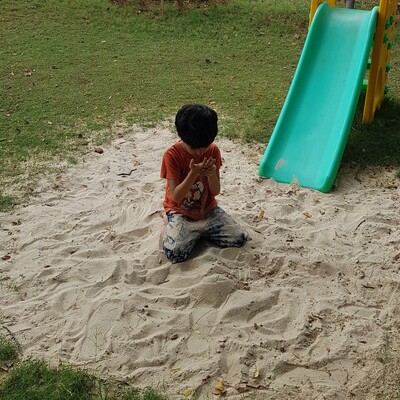
My son Krishna loves to clap and play with his fingers.
He also hits his hands, feet, and head against hard surfaces – the walls, the floor, or my skull if nothing else is handy. Sometimes it’s a gentle knock. And sometimes, not.
My husband and I didn’t understand any of this 6 years ago. And so we consulted the doctor.
“He’s autistic,” the doctor said. “These are behaviours that we expect. Start him on 0.5 mg risperidone.”
Dear reader, autistic children and perhaps adults present “behaviours” where the onlooker may not know the cause. The behaviour could be a type of stimming that is sometimes harmful to either themselves or others.
But please remember; there’s ALWAYS a very good reason for these behaviours.
Suppose that you aren’t autistic. Then imagine:
Something infuriates you. You are beyond angry.
What would you do? Rant? Scream? Cry? Break a plate or two? Go icily silent?
Suppose you are nervous. Or bored. You start wiggling your foot. Continuously.
All of these are behaviours. Taken in isolation, would not the onlooker be perplexed, and think, so-and-so was fine; why are they now running amok smashing plates? Let’s give them an antipsychotic drug. So-and-so was nice and calm; why are they now shaking a foot faster than Usain Bolt could? Let’s give them an antipsychotic drug.
The thing is that if you are neurotypical, you can explain why you reacted the way you did. Most of the times. (Sometimes neurotypicals too flounder if asked to explain their behaviour.)
The autistic child can rarely tell you the reason underlying the behaviour. And hence the antipsychotics. It’s like putting a heavy blanket on the visible behaviour to hide what’s still happening within the child.
And my personal opinion is that drugs aren’t always the answer.
If you are the parent of an autistic child, please investigate the reason for the behaviour. The doctor spends a maximum of 20 minutes with your child. You spend 24 hours. So you are the best possible person to figure out the reason.
In Krishna’s case, gut pain causes him to hurt himself and others. And he calms himself with tactile stims. Giving him risperidone is going to do absolutely nothing to remove the cause of pain.
This wasn’t something we discovered overnight. It takes time and patience to discover the cause of the behaviour.
As Krishna’s parents, we took a personal decision to not give him antipsychotic drugs till we’d investigated every possible physical cause for his pain.
Because antipsychotics are not “harmless.” Over time, the dose has to be increased.
The side effects may last lifelong.
The side effects may be atypical.
And Krishna, who is atypical in every other respect, typically presents atypical reactions to drugs. (Didn’t mean that to become a tongue twister!)
If after all possible investigations the cause of his pain is still unknown, then we will rethink our decision and research pain management.
Harmless stims are coping mechanisms. As long as they do not reduce the child’s quality of life or interfere with daily activities, why would anyone want to suppress them?
Dear parent of an autistic child, if it is the “What will those four people say” syndrome, no one is going to help out when your child acquires a fresh set of anxiety and stress issues because you denied them a natural coping mechanism.
So please, please be your child’s champion. If you don’t stand up for them, who else will?
I hope this is what you will take away:
Harmful behaviours may be rooted in pain. And any stim may have an underlying medical reason.